Door opening in Torrevieja: what happens at your door
Every locked door can be opened. The question is what survives it — and that depends on the lock, not on how hard anybody pushes.
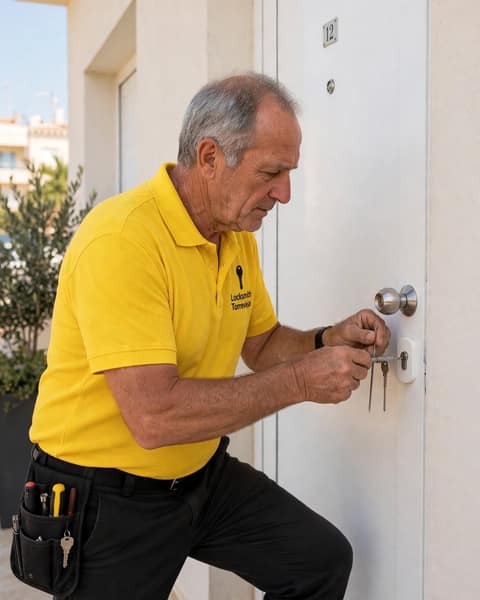
The method
What actually happens at the door
There is no single trick. The lock decides the method, and in Torrevieja four kinds of lock cover almost everything.
Euro cylinders
The standard in nearly every home built here since the 1980s, which is nearly every home. Depending on its condition and quality, a cylinder can often be opened and left in the door. A worn or salt-damaged one is less predictable: it can seize halfway through the attempt, and then it has to come out.
Multipoint mechanisms
Common in newer flats in Aguas Nuevas and Punta Prima, and in aluminium and uPVC doors everywhere. Here the cylinder is often fine and the gearbox has failed. Opening it is one job, replacing the mechanism behind it is another — and they are priced separately.
Older lever and wafer locks
Still found in older buildings in the centre, in La Mata and in the streets behind the port. Parts are not always available, so the decision is usually between keeping the original for the look of the door and moving to a modern cylinder.
Communal street doors
The door before your door. Almost every flat in the seafront blocks has one, and it belongs to the community rather than to you. It can be opened so you can get in, but changing it is the community's decision, not a resident's.
Before drilling
When a cylinder cannot be saved
Some locks cannot be opened without destroying them: high-security cylinders doing exactly what they were bought to do, mechanisms that have already failed internally, and cylinders full of salt and grit that will not move at all.
When that is the case you are told before anything is drilled, with the price of the replacement, so the decision is yours and not a surprise on the invoice. A drilled cylinder is replaced the same visit: you never get left with a door that will not lock.
- You hear it first, with the cost, and agree to it.
- The replacement goes in immediately, not on another day.
- The door and frame stay untouched. Only the cylinder is sacrificed.
What goes back in is a decision of its own: which cylinder, and to what standard.
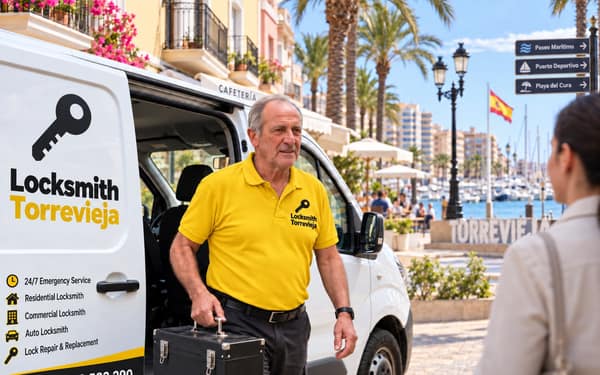
Around town
Doors this town is made of
Centre and seafront flats
Two doors before you are home: a communal entrance with its own cylinder, then your own. If both are stuck, say so — it is a different visit.
Bungalows in the estates
A gate, a front door and often a solarium door. Two homes can share one street number, so which unit you are matters more than the street.
Villas in La Veleta and Los Altos
A garden gate and a house door that rarely share a lock, plus large glazed doors at the back that open with a different mechanism entirely.
If the failure is a terrace or balcony slider rather than the front door, that has its own page. If you are standing outside right now, start with the emergency call-out, and if you are in a town further out in the comarca, check the coverage list.
Questions
What people ask before the van arrives
Does the door itself get damaged?
The aim is always to leave the door and frame untouched, and on most jobs that is what happens. The part at risk is the cylinder, not the door: some locks can be opened and kept, others cannot be opened at all without being destroyed.
How do you know which method to use?
From what the lock is. A euro cylinder in a bungalow front door, an old wafer lock in a town centre flat and a multipoint mechanism in an aluminium door are three different problems. That is why the first question on the phone is about the lock, not the address.
Can you prove I live there?
You are asked for proof that you have a right to the property before anything is opened: an identity document with the address, a contract, a deed, a booking confirmation, or a call to the owner or the agency. This applies to every job without exception.
The door is not locked, it is just stuck. Is that the same job?
No, and it is often cheaper. A door that will not open with a key that turns correctly is usually a mechanism or an alignment problem, particularly in aluminium doors that have moved in the heat. Say so on the phone and bring a photograph of the edge of the door.
Do I have to change the lock afterwards?
Only if the lock did not survive the opening, or if you no longer know who holds a key to it. Those are two separate decisions and you are told which one you are facing.
A door that will not open?
Describe what the key does and send a photograph of the lock. You will know which of these situations you are in before anybody touches the door.
Open 24 hours · 7 days